
Electric roller shutters for trade counters and industrial units
An electric roller shutter is a motor-driven security curtain for openings that go up and down through the day, and it suits trade counters, shops and workshop units. It is sized around what passes through the opening, then the drive is matched to how often it runs. Supplied and fitted, it costs £1,740 to £3,900 inc VAT.
Inc VAT. Business price £1,450 to £3,250 + VAT at 20%. Supplied and fitted, standard opening up to about 2.4 m by 2.5 m at the from price.
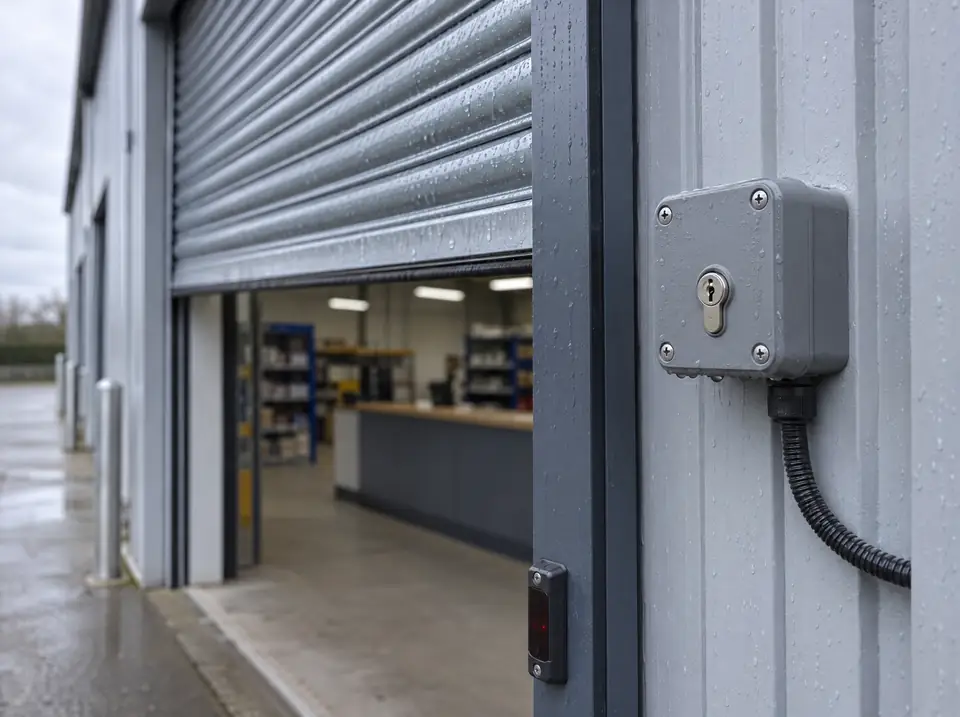
How much does an electric roller shutter cost?
An electric roller shutter costs £1,740 to £3,900 inc VAT, supplied and fitted. Anything larger than that range covers is quoted after survey. Two remote handsets and a receiver add £174, and a powder coat finish adds £234 to £474.
Allow a typical lead time of 2 to 3 weeks after survey sign-off. We fit around trading hours where possible. Closed-day or out-of-hours work can be arranged and may cost more.
How do you size an electric shutter for my opening?
We size it around what goes through the opening: customers and trolleys, pallets on a forklift, or a van with a roof rack. That sets the clear width and height, and the shutter is built to leave them free.
The drive comes next, matched to how often the shutter runs. Raised at opening time and lowered at close, a shutter does one cycle a day. A goods door in use all shift does far more, and wear follows cycles, so it needs heavier laths and a higher-duty drive.
What safety protection does a powered shutter need?
A risk assessment decides it, and no single answer fits every opening. The assessment looks at who can reach the shutter, how it is controlled and what could be trapped.
In Great Britain, regulation 18 of the Workplace (Health, Safety and Welfare) Regulations 1992 requires effective anti-trapping features on powered doors, and Northern Ireland has its own 1993 regulations. The usual routes are below. A safety edge is one option, not a universal requirement.
- Hold-to-run control, used under visual control
- A safety edge or force limitation
- Non-contact detection
What paperwork should come with an electric shutter?
You should get instructions and a Declaration of Conformity for the complete powered shutter. Whoever makes or assembles it must assess the complete machine and keep a technical file. A motor's declaration alone does not cover the finished shutter.
A Declaration of Performance is a different document, from construction product rules, and HSE notes it may not be required for some bespoke or in-situ products. BS EN 12453:2017+A1:2021 covers safety in use. Standards are a route to showing safety, and any other route must reach an equivalent or better level.
Which options can you choose?
| Option | What it is |
|---|---|
| Standard | Single-skin laths and a standard drive, for ordinary daily use. |
| Reinforced | Heavier laths and guides, for units that open several times a day. |
| Heavy duty | Heavy-gauge curtain and a higher-duty drive, for busy goods-in doors. |
| Remote handsets | A set of two handsets and a receiver, at £174 inc VAT. |
Quick answers on electric roller shutters
What happens to an electric shutter in a power cut?
It stops, and you move it with the emergency hand chain or override if one is fitted. Ask to be shown how it works at handover. If the shutter closes over an exit, your fire risk assessment must cover power failure.
Does every electric shutter need a safety edge?
No. A safety edge is one possible protection, and the right one comes from the risk assessment. Hold-to-run control under visual control, force limitation and non-contact detection are the alternatives.
Can an electric shutter be used as a fire exit?
Normally no. Guidance for offices and shops in England and Wales says roller shutters are not normally suitable as final exits. In Scotland and Northern Ireland, ask your fire risk assessor how the rules apply. The possible exception is a small number of familiar staff in a normal-risk area, where the opening is unobstructed and can be opened by hand at once.
How long does an electric shutter last?
As a rule of thumb, a well-made commercial shutter is generally reckoned to last around 10 to 20 years. Busy goods-in doors sit at the low end, because wear follows cycles.
Do you sell fire-rated electric shutters?
No. A fire shutter is a different product from a security shutter, and we do not sell them on this site. BS EN 13241:2003+A2:2016 does not cover fire-resistance performance either.
What else might you need?
Guides to read first
Where do you fit electric roller shutters?
Across the UK. Pick your area for local planning notes and places.
- Bedfordshire
- Berkshire
- Bristol
- Buckinghamshire
- Cambridgeshire
- Cheshire
- Cornwall
- Cumbria
- County Durham
- Derbyshire
- Devon
- Dorset
- East Riding of Yorkshire
- East Sussex
- Essex
- Gloucestershire
- Greater London
- Greater Manchester
- Hampshire
- Herefordshire
- Hertfordshire
- Isle of Wight
- Kent
- Lancashire
- Leicestershire
- Lincolnshire
- Merseyside
- Norfolk
- North Yorkshire
- Northamptonshire
- Northumberland
- Nottinghamshire
- Oxfordshire
- Rutland
- Shropshire
- Somerset
- South Yorkshire
- Staffordshire
- Suffolk
- Surrey
- Tyne and Wear
- Warwickshire
- West Midlands
- West Sussex
- West Yorkshire
- Wiltshire
- Worcestershire
- North Wales
- South West Wales
- Gwent
- Gwynedd and Anglesey
- Bridgend, Merthyr and Rhondda
- Powys
- Cardiff and the Vale
- Swansea and Neath Port Talbot
- Aberdeen and Aberdeenshire
- Argyll and Bute
- Ayrshire and Arran
- Dumfries and Galloway
- Dundee and Angus
- Edinburgh and the Lothians
- Fife
- Forth Valley
- Glasgow and Clyde
- Lanarkshire
- Highlands
- Moray
- Perth and Kinross
- Scottish Borders
- Scottish Islands
- County Antrim
- County Armagh
- County Down
- County Fermanagh
- County Londonderry
- County Tyrone
Have an opening to price?
Your guide figure comes from the size of the opening and how often it runs.